How to Build an Email List with Your Link in Bio (2026)
 Marcel Cruz
To build an email list from your link in bio in 2026: offer something specific worth an email (a PDF, a free template, a weekly digest with real value), place the email-capture block as the first or second item on your bio page, use a bio link tool whose form block can export submissions to a real email platform (Mailchimp, ConvertKit, Beehiiv, Mailerlite, Substack), and follow up with a five-email welcome sequence. The offer matters more than the tool. Most creators skip the offer step, capture nothing, and blame the tool.
Email still returns roughly $42 for every $1 spent (Litmus 2026 industry benchmark). A typical creator bio link sees thousands of monthly clicks. Sending those clicks to a generic Linktree that captures zero emails is the single biggest leak in the creator funnel.
Why a Bio Link Is Your Highest-Converting Email Surface
Three things make a bio link convert better than ads, popups, or content upgrades.
The audience is already warm. Someone who tapped your bio just chose to investigate you. They are not cold traffic. They opted in to one micro-conversion already.
The context is mobile-first and one-tap. Email signup on a desktop popup requires typing on a keyboard. From Instagram, the iOS keyboard is already up and the email field is one tap away.
The impressions repeat. Every Instagram visitor who taps your bio sees the same page. A pinned offer compounds: every viral Reel, every new follower, every Story tap routes through it.
A landing page on your website needs traffic. A bio link gets traffic for free, every day, from a platform you do not control. Treat it like the highest-value square meter on your site.
The Offer Comes First, the Tool Comes Second
"Subscribe to my newsletter" converts at 1 to 3% of visitors. A specific lead magnet ("Get my 10-page Notion content planner") converts at 5 to 15% of visitors and sometimes higher. The tool is almost irrelevant compared to the offer.
What works as a lead magnet in 2026:
- A specific PDF or template (workout plan, content calendar, recipe pack, Notion dashboard)
- A free mini-course delivered as a 5-email drip
- A weekly digest with a concrete promise ("the three creator deals I shortlisted this week")
- A free tool or calculator (pricing calculator, color generator, hook generator)
- A members-only resource library (single signup, lifetime access)
What does not work: "join my community," "sign up for updates," "get the latest from me." These are not offers. They are requests.
The test is simple. Would you give your email address for this offer? If the answer is no, your audience will not either. If you are not sure, ask three followers what they would actually use. Build that.
Where to Place the Email Capture on Your Bio Page
Position determines capture rate more than design does.
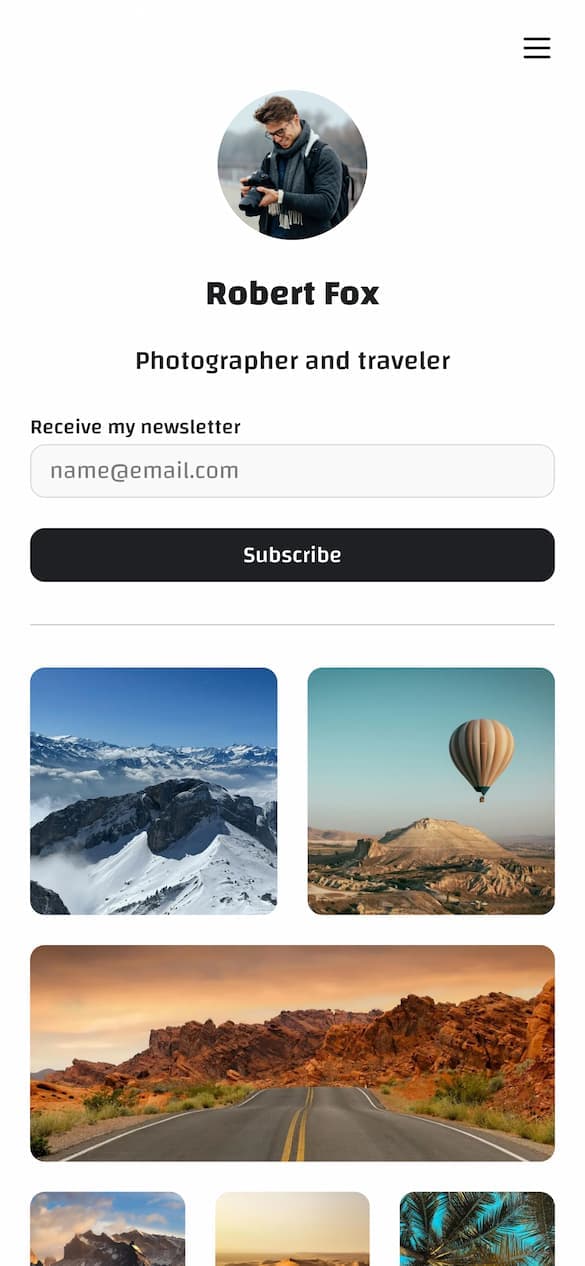
Top block. Highest capture rate. The lead magnet headline is the first thing the visitor reads. Tradeoff: less Instagram traffic flows through to your store, podcast, or paid offers.
Second block, right after your main link. Balances email capture with funnel routing. Best fit for creators who already have a primary destination (latest video, current launch, podcast) and want email as the secondary capture.
Below the fold. Minimal capture. Only fits creators who prioritize commerce or paid product clicks above list growth. Most creators picking this position are accidentally picking it. They added the email block last and never reordered.
The principle: the email address is your long-term asset. Paid links are seasonal revenue. The asset gets the better real estate.
For more on bio-link sequencing, see what to put on a link in bio and the broader link in bio design and conversion breakdown.
Build Your Page in Minutes
Drag-and-drop editor with 18 content blocks, per-block styling, and custom themes.
Create your pageBio Link Tools That Actually Capture Emails
Not every bio link tool gives you a real email-capture path. The bar is: can the tool capture an email, store it reliably, and pipe it to the email platform that will actually send your newsletter?
Linkero. Native Form block with text fields, custom labels, in-app reply notifications, CSV export, email notifications on new submissions (Pro plan), and webhooks on new submissions (Pro plan). The webhook gives you a clean handoff to Mailchimp, ConvertKit, Beehiiv, Mailerlite, or Substack via your own endpoint or Zapier as middleware if you prefer no-code. Pricing details live on the pricing page.
Linktree. Email collection is gated to paid tiers (Pro upward). Lower tiers do not capture emails at all. For the broader breakdown, see Linktree free vs Pro: worth it?.
Beacons. Built-in email capture and built-in sender. Convenient on paper. In practice, community reports flag reliability issues with the email module, including account suspensions and slow support. See the Beacons email reliability concerns breakdown before committing your list to the same tool that hosts your bio.
Stan Store. Buyer-list oriented. Captures emails as part of a purchase, not as a standalone newsletter signup. If your goal is selling digital products and getting buyer emails, fine. If your goal is building a newsletter, wrong fit.
Bento. Was popular for email capture through 2025. Redirected to Taplink in early 2026. Do not start here in 2026.
If you are in the EU and worried about consent, processing location, and GDPR retention rules, see the GDPR-compliant Linktree alternative breakdown for the consent and data-handling angle.
Connect Your Bio Link to a Real Email Tool
The most common mistake is treating the bio link tool as both the capture surface and the sender. They are different jobs.
Capture is a UX problem: short form, clear value, instant delivery. Most bio link tools do this well.
Sending is a deliverability problem: SPF, DKIM, DMARC, IP reputation, list hygiene, automation. Dedicated email platforms (Mailchimp, ConvertKit, Beehiiv, Mailerlite, Substack) spend engineering effort on this every week. Bio link tools usually do not.
The bundled "all in one" pitch is appealing until something breaks. When the same tool hosts your bio page, your form, your email database, and your sender, a single outage takes down your entire creator funnel. That is the structural risk behind the Beacons email reliability issue: when one product fails, multiple revenue paths fail with it.
The clean stack: bio link tool captures, webhook (or Zapier middleware) pushes to your email platform, email platform owns the list, sends the welcome sequence, and runs broadcasts. If the bio link tool ever shuts down or breaks, your list is safe on the email platform.
The 5-Email Welcome Sequence
A welcome sequence is non-negotiable. It is the difference between a list of strangers and a relationship.
Email 1, instant. Deliver the lead magnet. Direct link to the PDF, course, or resource. One sentence of context, one button. Do not pitch yet.
Email 2, day 2. Origin story. Why you make what you make, in 200 to 400 words. End by asking permission to keep emailing them, framed as "if this is not for you, here is the unsubscribe link, no hard feelings."
Email 3, day 4. Your best-of content or most popular post. Demonstrates value. Builds trust before any pitch.
Email 4, day 7. Soft call to action toward a paid product, service, or consultation. Frame as "here is the next step if you want it." Do not pressure.
Email 5, day 14. Ask one question that invites a reply. Replies are segmentation gold. Anyone who replies is your highest-value audience segment.
Most creators ship the lead magnet (email 1) and stop. The compound value of emails 2 through 5 is enormous. Write them once and they run for every new signup forever.
How to Promote the Email Capture Beyond the Bio
The bio link is the destination. Social is the traffic source. Driving more traffic to the bio is its own job.
- Pin a post or Reel promoting the lead magnet directly. Caption: "PDF in bio."
- Mention the lead magnet in Stories at least weekly. Use a sticker poll or question to drive interaction before the bio tap.
- Use TikTok captions and TikTok bio to drive to bio link. For the TikTok specifics, see link in bio for TikTok.
- Add a P.S. with the lead magnet link to every YouTube description.
- Drop the lead magnet link in podcast show notes if you guest on shows.
If you are getting bio traffic but no email signups, the problem is the offer or the placement, not the channel. If you are getting no bio traffic at all, the problem is the social content, and no bio strategy will fix that.
Tracking: Did It Work
Numbers worth watching weekly:
- Bio link clicks to email signup conversion rate (target: 5 to 15% on a strong lead magnet)
- New signups per week as your follower count grows (target: scales roughly linearly)
- Open rate of the welcome email (target: 50% or higher because intent is fresh)
- Reply rate on email 5 (target: 1 to 3% replying is a healthy list)
UTMs help. A query string like ?utm_source=ig_bio&utm_content=notion_planner tells your email tool where each signup came from. When you compare two lead magnets, the UTM is what makes the comparison clean. For the broader analytics setup, see link in bio analytics: what to track.
Use the bio link tool's analytics and the email tool's analytics together. The bio tool tells you which block got clicked. The email tool tells you which signups stayed and engaged. The story is in both.
Common Mistakes Creators Make Building a List from Bio
- "Subscribe to my newsletter" with no specific value attached. Generic CTA. Sub-2% capture.
- Email block buried at the bottom of the bio page. Sub-1% capture. Most visitors never scroll that far on mobile.
- Lead magnet that does not deliver real value (a 2-page PDF of platitudes). Kills trust on email 1.
- Capturing emails and never following up. The list rots silently and your sender reputation suffers when you finally email three months later.
- Relying on the bio link tool's built-in sender for broadcasts. Deliverability suffers and one outage takes down everything.
- Setting up the capture, getting 50 signups, declaring it broken. 50 signups is enough to learn from, not enough to write the strategy off.
If your list is leaking, it is almost always offer quality, position, or follow-up. Rarely is it the tool itself.
FAQ
How do I capture emails from my Instagram bio?
Use a bio link tool with a built-in form block. Add the form as the first or second block, with a specific lead magnet headline (not "join my newsletter"). Connect the form output via webhook or CSV export to your real email platform (Mailchimp, ConvertKit, Beehiiv, Mailerlite, or Substack). Send the welcome email instantly and follow up with a 5-email sequence.
Can I add an email signup to Linktree on the free plan?
No. Linktree gates email collection to paid tiers. To capture emails on Linktree you need to upgrade. Tools like Linkero include a form block that captures emails without the same gating.
What is the best link in bio for email capture?
Whichever bio link tool gives you (1) a form block that captures email addresses cleanly, (2) a reliable export path (CSV, webhook, or direct API) to your real email platform, and (3) does not bundle the sender in the same tool. Linkero, Linktree Pro, and Beacons all capture emails. Linkero and Linktree Pro export to your real email tool. Beacons pushes you to its own (less reliable) sender.
How do I connect my bio link to ConvertKit, Mailchimp, or Beehiiv?
The cleanest path is a webhook from your bio link tool's form block to a webhook endpoint exposed by your email platform (or to Zapier or Make as middleware). The bio link tool fires a webhook on each new submission. The middleware or endpoint adds the contact to the right list with the right tags. Setup time: 15 to 30 minutes the first time, zero ongoing maintenance.
Should I use my bio link tool's email feature or a dedicated tool?
Use a dedicated email tool for sending. Use the bio link tool only for capturing. Bundled "all in one" tools save 15 minutes of setup and create a single point of failure for your entire funnel. Dedicated email tools handle deliverability, automation, and segmentation in ways bundled tools rarely match.
What is a good email capture rate from a bio link?
5 to 15% of bio link visitors signing up is healthy on a specific lead magnet. Under 2% means the offer is generic or the position is wrong. Over 15% usually means a very targeted audience and a very specific offer.
How do I write a lead magnet that converts?
Pick one specific problem your audience repeatedly asks about. Solve it in a format they will actually consume (PDF, video, template, mini-course). Give it a concrete name ("the 14-day Reels script template") instead of an abstract one ("creator resource pack"). Test the headline against your audience by asking three followers if they would tap on it.
What to Do This Week
Pick one lead magnet idea you can ship in two days. Build it. Add the form to your bio link as the top or second block, depending on whether email or a primary link matters more to you right now. Connect the form to your real email platform via webhook or CSV. Write the five welcome emails. Promote the offer in one pinned post and in Stories for a week.
Measure capture rate, follow-up open rate, and reply rate at day 14. Adjust the offer if capture is below 2%, the position if traffic is fine but capture is low, or the follow-up sequence if signups are dropping off before email 3. The bio link itself is rarely the bottleneck. For broader leakage diagnostics, see fixing leaky link in bio funnels.
Create Your Link-in-Bio Page
All your content in one customizable page. 18 content blocks, custom domains, and built-in analytics.
Create your page