Link in Bio for Photographers: A Portfolio Page That Books Clients
 Marcel Cruz
The best link in bio for photographers answers three questions before a client has to ask: what do you shoot, how good are you, and how do I book you? If your bio page is a plain link list pointing to your website homepage, it is failing at all three.
This guide covers what to put on a photography bio page, how to structure it to drive bookings, and what most photographers get wrong when they set one up.
Why Your Bio Link Loses Bookings Before You Know It
Instagram is where couples find their wedding photographer, where brands discover commercial shooters, where parents book portrait sessions. Photographers use the platform better than almost any other profession.
But there is a gap. A potential client sees a photo they love, taps your profile, reads your bio, and clicks your link. They land on a generic link list with three unlabeled buttons, or your website homepage with a navigation menu pointing in six directions.
That click is the moment Instagram hands the lead to you. What happens in the next ten seconds determines whether they book or hit back.
What Photography Clients Actually Look For
Photography clients are not clicking your bio to browse. They are evaluating you as quickly as possible. They want to answer:
- Can I see more of your work? Not just the nine squares on your grid.
- Do you shoot my type of session? Wedding, portrait, commercial, newborn?
- Are you available, and how do I reach you?
- What does it cost? Or at least, where do I find out?
A generic link list answers none of this. A well-built photographer bio page is designed for the specific decision a client is making: whether to inquire. For a broader look at how Instagram users interact with bio links, see our guide to link in bio on Instagram.
The 5 Links Every Photographer Should Have in Their Bio
Not everything belongs on a bio page. Photography clients are decisive, and a page with ten items creates friction. Keep it to five to six focused links.
1. Portfolio gallery A curated collection beyond your Instagram grid. Link directly to your portfolio page on your website, or to a full Pixieset or ShootProof gallery. The goal is more examples of your best work, not more navigation choices.
2. Book a session Label this specifically: "Book Wedding Photos," "Book a Family Session," "Inquire for Commercial Work." A vague "Contact" label makes clients do the work. A specific label does it for them.
3. Investment or pricing guide Either a pricing page on your website or a downloadable PDF. Photographers who hide pricing lose the clients who are serious and ready to commit. Those who show it filter inquiries to the right audience.
4. Current availability A "Now booking Fall 2026" line at the top of your page handles more objections than you would expect. If you are fully booked, update it: "Joining waitlist for Spring 2027." This prevents wasted inquiries and keeps warm leads connected.
5. One secondary resource (optional) A behind-the-scenes reel, a client FAQ, or a downloadable session prep guide. One secondary link that supports the primary booking action, not competes with it.
How to Structure Your Photography Bio Page
Order matters as much as content. Build from highest urgency to lowest.
Top slot: availability and specialty "Now booking Fall 2026 portrait sessions in Barcelona." One line, updated seasonally. This surfaces the most time-sensitive information and filters your audience immediately.
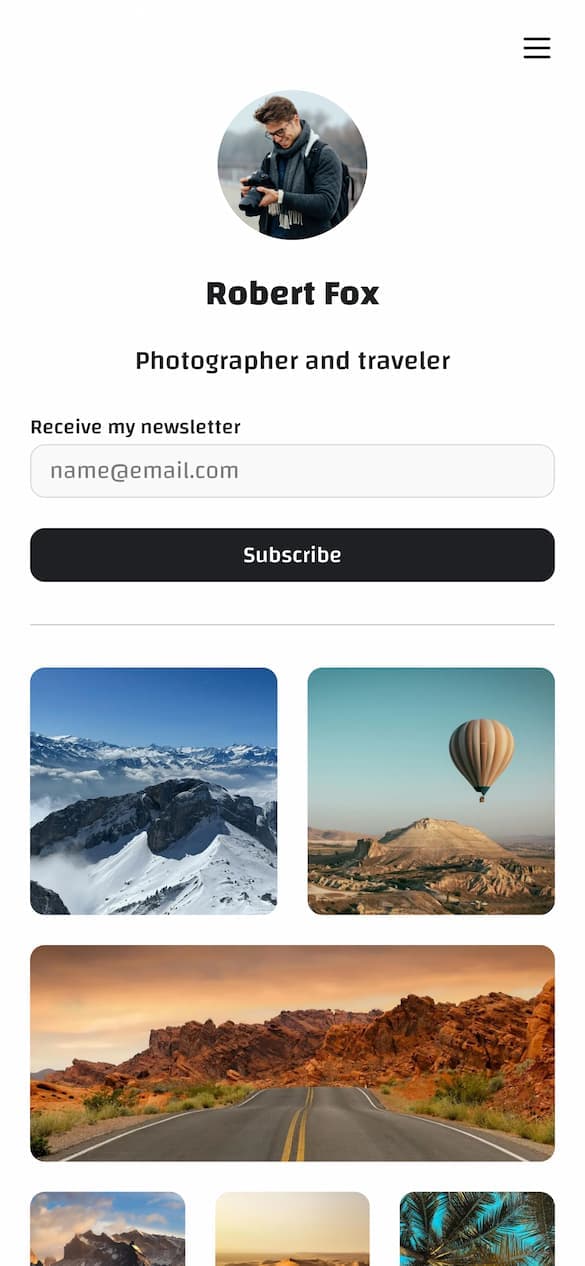
Visual preview If your tool supports image blocks, use them. Show three to four portfolio images directly on your bio page. This extends the visual experience your Instagram grid started.
Primary CTA One button, above the fold: "Book a Session" or "Inquire Now." Not "Learn More," not "Visit My Website." Something that starts the conversation with one tap.
Secondary links Portfolio gallery, pricing guide, and one optional resource below the fold.
Six items maximum. Photography clients who scroll past six links have already decided they are not inquiring. Design for the conversion, not the comprehensive catalog. For design principles that apply to any bio page, our link in bio design guide covers layouts that drive clicks.
Build Your Page in Minutes
Drag-and-drop editor with 18 content blocks, per-block styling, and custom themes.
Create your pageThe Portfolio Preview Problem
Most photographers link to their website homepage. That is a mistake.
When a potential client lands on a homepage, they navigate to the portfolio section, figure out which gallery to click, and eventually find examples relevant to what they want to book. You have added four to five clicks between your Instagram bio and your actual work.
The better approach is a direct link. Link to the specific gallery page on your site, or use an image block inside your bio page to show three to four images with a "See Full Gallery" link beneath them. The second option keeps the visitor in your bio page context, which typically converts better than bouncing to an external site immediately.
For photographers using gallery delivery tools like Pixieset or ShootProof, you can link individual gallery collections directly from bio page blocks. A "Sample Wedding Gallery" button pointing to a curated proof collection is more compelling than a homepage link.
The Booking Link Problem
This is where most photographer bio pages fail. The visual experience looks great, the portfolio section is solid, and then there is nothing actionable. "Email me at hello@photographer.com" buried at the bottom is not a booking link.
What works:
- A Calendly or Acuity link for discovery calls
- A Typeform or Google Form for detailed inquiry submissions
- A dedicated booking page on your website, linked directly rather than via the homepage
Label the button for what the client is doing: "Schedule a Call," "Submit an Inquiry," "Check Availability." Clarity about the next step removes the hesitation that kills conversions.
If you are between sessions or temporarily not accepting new bookings, update the button to "Join the Waitlist" with a simple form. Warm leads captured now are booked clients three months from now.
Keeping Your Bio Page Current: A Seasonal Rhythm
Photographers who get the most from their bio page treat it like a storefront window, not a set-and-forget link. Here is what to update and when:
| Period | What to update |
|---|---|
| January/February | "Now booking Spring sessions" in the top slot |
| March/April | "Spring availability filling — inquire now" |
| May to July | "Golden hour summer sessions, limited spots" |
| August/September | "Holiday mini sessions booking open" (portrait photographers) |
| October/November | "Gift certificates available, 2027 wedding dates open" |
| December | "Now booking 2027" with early-bird framing |
These updates take two minutes. The difference between a bio page updated monthly and one last touched a year ago is the difference between a client inquiring and assuming you are unavailable.
If your work overlaps with travel, the rotation gets more aggressive: current destination, fresh gear picks, location-specific affiliates. Our link in bio for travel creators guide covers the itinerary-driven version of this pattern.
FAQ
What should a photographer put in their Instagram bio link?
Lead with current availability and specialty, then add a portfolio link, a booking button, a pricing resource, and optionally one secondary link such as a FAQ or session prep guide. Keep it to six items maximum.
How do photographers get bookings from Instagram?
The booking path is: compelling photo in feed, profile visit, bio click, clear booking button. Each step needs to work. A generic link list breaks the chain at the bio click.
Do I need a website if I have a link in bio page?
A bio page handles portfolio display, booking links, pricing information, and social proof without a full website. For SEO and long-form case studies, a website wins. For converting Instagram traffic into inquiries, a well-built bio page covers everything you need to start.
What is the best link in bio tool for photographers?
Look for a tool that supports image blocks for portfolio preview, multiple block types for different content needs, and mobile-first design. A plain link list is not enough for photographers. Check our guide to creating your first bio page for a full setup walkthrough.
How often should a photographer update their bio link?
At minimum, seasonally (four times per year). In practice, every time your availability changes, a new gallery is ready, or you add a new service. If updating your bio page takes more than five minutes, you are using the wrong tool.
Build the Page That Books Clients
Most photographers invest hundreds of hours into building a portfolio worth clicking through. The bio page is the ten-second window where that portfolio either makes its case or loses the lead.
A plain link list signals "I set this up once and forgot about it." A well-structured photography bio page signals "I care about the client experience from the first tap." That impression forms before a client has seen a single photo beyond your grid.
If you work across multiple clients or niches, our guide for freelancers covers portfolio page structure that applies across creative professions.
Build Your Page in Minutes
Drag-and-drop editor with 18 content blocks, per-block styling, and custom themes.
Create your page